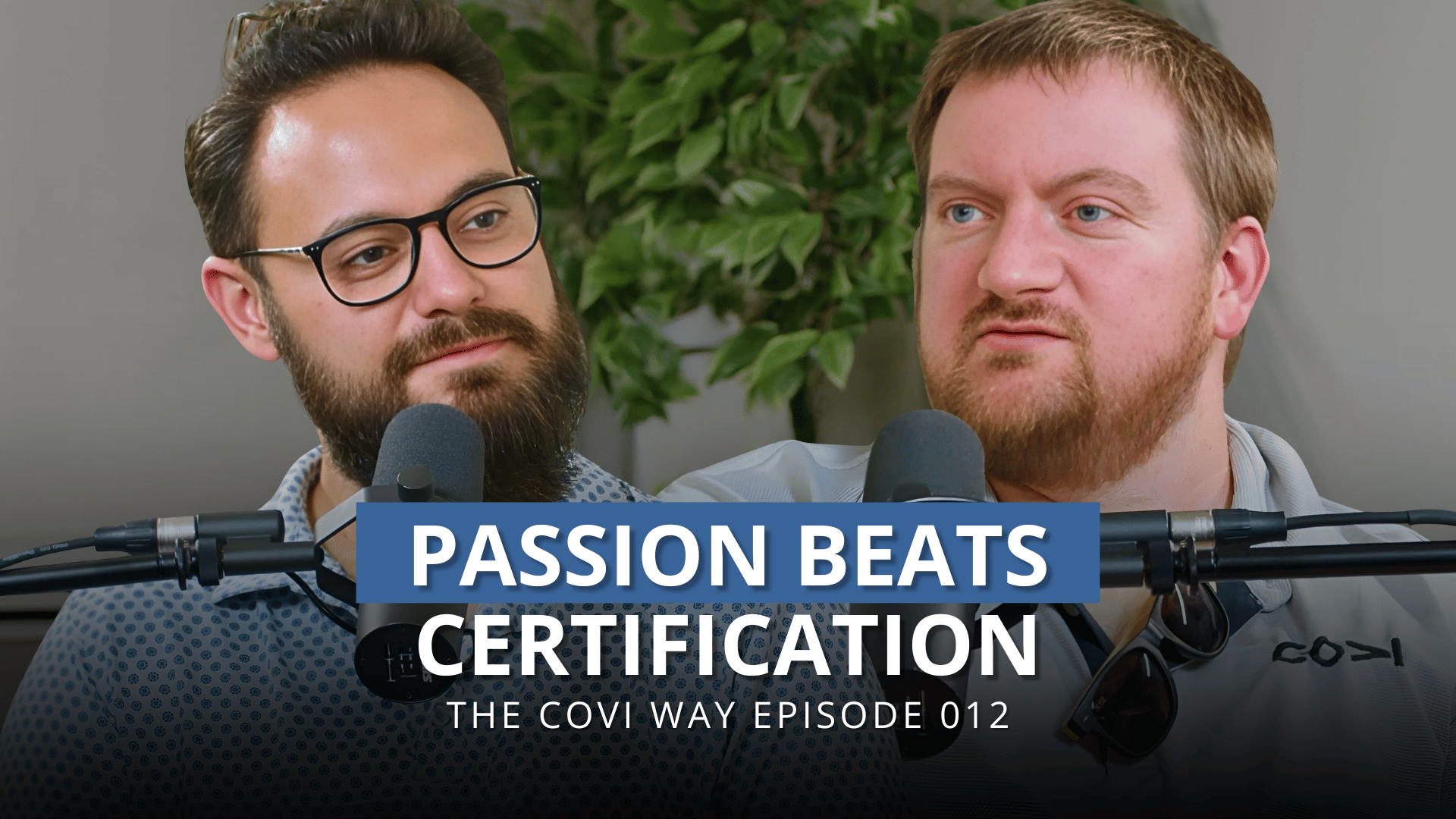
Why Security Can’t Wait: The Hidden Cost of Delayed Investment & Why AI Won’t Replace The Need For Trust
Jack Musick’s journey from a curious teenager dreaming of working at Best Buy to becoming COVI’s Chief Technology Officer spans 16 years of hands-on learning and problem-solving. His origin story began with a naive question in high school programming class about building an operating system, but crystallized during a pivotal moment in 2013 when he stepped up after losing his mentor, Bill. Rather than being overwhelmed by the responsibility of protecting client data and systems, Jack discovered his core strength: confidence not in knowing everything, but in his ability to figure things out. This mindset has carried him through countless technical challenges and shaped his approach to leadership.
The intersection of technology and human needs defines Jack’s philosophy at COVI, particularly when implementing security policies that users often resist. His approach starts with genuine curiosity about what problems people are actually trying to solve, rather than immediately prescribing technical solutions. This empathy-driven method builds the trust equity necessary for later conversations about necessary standards and security measures. Jack emphasizes that listening first and understanding the business context transforms potentially adversarial relationships into collaborative partnerships, whether dealing with frustrated users or explaining why certain security protocols cannot be bypassed.
Looking ahead, Jack sees AI as the next major productivity catalyst for businesses, but warns against the common trap of implementing technology for technology’s sake. The most valuable AI applications solve specific, well-defined problems that genuinely improve workflows - like instantly locating scattered files across multiple platforms or automating routine tasks that consume valuable time. He advocates for intentional, tested implementations that enhance human capabilities rather than replace them. Meanwhile, security remains the most critical under-investment for organizations, with Jack noting that proactive measures are always less disruptive and expensive than reactive responses to breaches or ransomware attacks.
https://youtu.be/DWvwLzeb5hE?si=oyMyOxGRncJmCgR3
Episode Summary:
In today’s episode, we learn about leadership from Jack Musick, CTO of COVI, and how he uses technology solutions to empower people. This empowering podcast highlights the importance of developing people and fostering a strong organizational culture within a tech company. Learn how simple solutions can enable teams to thrive.
Key Topics:
-
Find your passion in tech before worrying about certifications—curiosity and persistence matter more than credentials
-
Security is the most underinvested area in business technology, and waiting until after an incident costs far more
-
Build “trust equity” with users by listening first and prescribing solutions second
-
AI’s real value lies in accessing existing knowledge and automating routine tasks, not replacing human connection
-
Every piece of technical knowledge you gain compounds—nothing learned in tech is ever wasted
Connect with COVI:
Instagram | Facebook | Website | FREE IT Strategy Analysis
Links to The COVI Way Podcast
YouTube | Apple Podcasts | Spotify
Episode Transcript
The COVI Way - Episode 12
Featuring Dave Vint and Jasck Musick
Welcome to The COVI Way, the podcast where we break down the intersection between people and technology. Because IT shouldn’t just be about solving problems, it should be about enabling people to do their best work. Today, we’re sitting down with Jack Musick, CTO and longtime employee of COVI. We’re going to talk about his history, the things that make him tick, and some of the trends that he’s seeing in our industry today. Let’s get started.
Dave: All right, Jack, welcome to The COVI Way. Hopefully, the first of many conversations between you and I, so we dig into more of the technical world of COVI. I’m really excited for this conversation. Hope you are too.
Jack: Yeah, me too.
Dave: Cool. Awesome. All right. Let’s jump in with some fun questions. I’m going to do an overly broad one. You ready? I want to dig into your hero origin story. Your hero origin story. What moment did you realize you were cut out for tech?
Jack: I mean, I could have always knew even if I shouldn’t have known. Forbidden knowledge. Oh, where we start. So the wrong ones were, you know, when I was in high school at Gilbert Light, I was in a programming course. The teacher was telling us all sorts of stuff and I was like, “Hey, so can we, at the end of this course, do you think I’ll be able to make an operating system?” Big goals. It was a big moment of naivety for me, realizing just how much I didn’t really know. And then seeing the first one I could and realizing like, oh, this is like math. I might not be able to do this.
I think the real one where I think it was an honest sense of confidence was when Bill died. So Bill used to work with us. He was there actually before me. I just didn’t know it back in 2018, I believe. And he was kind of the first professional coworker that I worked with. It was kind of a mentor. He was our lead, but we were three people. And all of sudden, I think it was in 2013, he had to go to the hospital and he passed away a week after that, just over some little pain.
So the founder and I were driving around in the car and saying, maybe we shouldn’t even be driving together. And I don’t know. The things that should have occurred to me were like, I don’t have the experience to do this. Like, what about the clients? What about their data? Can I protect their stuff? And just kind of jumped into it. And I didn’t really have a lot of hard misses that you would expect. So I think at that point, just ever since then, there’s not really any emergency that really makes me panic or anything. I just can’t say that I’ve seen it all. But the thing that really prepared me was just the sense of you know, maybe I’m not confident that I can do it, but I’m confident that I can figure it out. That’s led me all the way here.
Dave: That’s really cool. I had the pleasure of working with Bill for a really short period of time. He provided a lot of mentorship to me as well. And such a dork. He’s coming to Halloween wearing a stormtrooper outfit, which is just hilarious. And yeah, that was a good soul. I couldn’t believe it when I heard what had happened. So, makes you realize that like how, now you got to take advantage of every moment.
Jack: That’s right. That’s right.
Dave: Man. I know it’s been a long journey. How many years has it been that you have been working with computers? I know a lot of that has been with COVI slash Netlink. What’s the total length?
Jack: I mean, COVI is 16 years, which I feel like is the real time. I mean, before that, I mean, I’d always like my dad got me a computer. It had been a used computers like a Pentium 3D windows. Was it the 98 processor or was it the… I couldn’t tell you? I think I don’t know if I even opened it for any reason other than to replace my hard drive, which I couldn’t do. I failed at doing that. And I mean, since then, I just tinkered with the amount of times that I broke that stupid thing. I remember trying to put Windows XP on it and calling the guy who gave it to him. And he’s like, why are you calling me?
And I mean, after that, like this thing eventually died and you know, I got my grandma’s old Windows 95 laptop briefly that didn’t do anything. You know, my mom bought me a laptop and that thing I beat to death. I mean, it was a little inspiron and it had a corner that every single one of those would always come apart. And I reinstalled stuff. I tried to Mac OS on it. I tried to put this on at one point when I put this on it. I stopped the installation at 90 percent when I was getting on the school bus and I thought, I mean, what could that 10 percent be? You know, it’s just a naivety like at that age. I’m just like, I wonder. And then I get in the bus and of course it’s not doing anything.
Dave: Well, did you know the last 10 percent of the installation of this was the least of your…
Jack: It was so imaginative thinking like maybe they just… Maybe I’ll just notice certain things are missing. Nope.
Dave: That’s great. It’s not how computers work. That’s amazing. Yeah. What has been your favorite part of your journey so far in learning computers and specifically with the coding side?
Jack: It’s really the problem solving nature of it, especially breaking out problems that aren’t exactly like commonly solved problems. Coding especially like, I mean, at least before AI, I mean, everything was kind of a mystery, especially if you’re a novice. So you figured out everything with documentation, obscure posts on the internet, links to things that no longer exist, dabbling and figuring something up. And there’s just nothing more satisfying, I think, than solving a problem that probably has been solved. Like, I didn’t, somebody didn’t tell me how to do it. You know, worked my way through it. So coding definitely gives that, but IT gives the exact same thing. There’s so many problems out there that we’ve, and I’ve resolved that I just… Nobody tells you how to fix it exactly. You are putting it together yourself. It’s like putting somebody breaking Legos and putting it together. Every time.
Dave: Yeah, that’s super cool. Tell me early in your IT career, what did you believe about the industry that you see as so different now?
Jack: Couple of things, but they’re really kind of small. There’s nothing really profound. When I was 16, my dream was to work at Best Buy. So I thought like, I mean, I saw my friends working at McDonald’s and I thought that’s cool. And I got an interview at 16 and I didn’t know what to do with it. Completely failed it, obviously. And there are little things that like, I remember when I first started working at COVI Netlink, I guess, and Bill was telling him about servers. I mean, I’d never seen a server. I’d never seen a data center. I just, my imagination went wild and I was thinking like, what could it look like? What could it be? A pretty interface is it? And you look at it it looks like Windows 98.
So the thing that was demystified for me was that like, oh, business, a lot of it’s pretty boring. You know, so at an early age, it didn’t take me long to find the appreciation for like the problem solving aspect of it and not the aesthetic that I had like hallucinated essentially. Yeah. So things like that it’s and then over the years, like the thing that’s… It hasn’t perfectly solidified, but the idea that like most people don’t, you know, they want their stuff to work. They don’t want to get hacked. They want to be able to restore their data. They don’t find it as fun as I do, and that’s OK. And even people in the industry like, you know, a lot of people, they work to live and they’re not going home excited about the latest tech news or whatever.
So the thing that was demystified there for me is that, you know, that doesn’t mean that they can’t figure it out. It shouldn’t. I just took it totally different, weird journey. And I need to understand what the norm is and how to be successful. And for the record, I haven’t, but I need to.
Dave: I think we would both say in different categories in different sections, different verticals, you might say that as the fun of the journey, the fact that it’s ever evolving, it’s never stopping. There’s always something new to learn. And to stay stagnant is it’s not just to fall behind.
Jack: Yeah, it’s to stop. Yeah. It puts you in a rut for sure. I don’t like repeating anything. Yeah. Yeah. Laundry. Laundry. I mean, like I thought about it I thought, how could somebody possibly automate this? And I, well, we could have standardized clothes and like, could live with that. Yeah, everything else. I mean, even at work, lot of me things that will take way less time to do manually. Cause I just don’t want to ever have to repeat it again. Cause it’s monotonous. And I think that’s probably what’s gotten me through it. A lot of people, they have a burnout period and they go do something else. And I’ve definitely had burnout periods, but I don’t think you get to like 16 years because by repeating the same loop every day, checking backups manually or whatever it may be.
And that’s okay too. Like it’s okay to like change careers in your life. Certainly. I would just rather work on the novelty of it as long as I possibly can. And I feel like that’s kind of a best kept secret about the technology world. I’ve coached people often to say like, climb the mountain aggressively. It’s okay. Worst case scenario, you’ll see the other mountain peaks more easily and you’ll know where you’re going. But what’s fun about IT is like, it’s a mountain range in that there are so many other adventures and paths and journeys that you can go on and you can climb as fast and as hard as you want and you’re not losing any time, really.
Its context and its awareness that will probably help you in your specialization. Oh, yeah, I should start writing down examples because the amount of like things that I’ve learned that just feel meaningless and then all of sudden like pop up and are relevant to like a current issue or something that we project we’re tackling is just it’s astounding how I don’t feel like there’s any even if the stuff I don’t work in every day, there’s not like a single thing that I’ve learned and gotten decent at that I didn’t use again. And it was really thankful that I got good at it.
Dave: Oh, that’s good. So I feel like a lot of people are, they, you know, wonder when they’re growing their careers, like, well, what should I focus on? What certificate should I get? And I mean, I can only speak as somebody who’s like been in the small business for as long as I have, but I would say like, none of it, just find something you’re willing to do and work through it. And even if it’s not something you will immediately use at your job, if you do that and then find something else interesting to tackle, eventually you will just find all that knowledge builds up. And even if you don’t even use it, the awareness of it is going to get your mind thinking about it as a technologist. And that’s way more important than like worrying about exactly what documentation you should read or course you should take.
I’ve taken a few courses and that’s like it. I mean, I won’t take them. There’s a point where a brand new topic, maybe, but there’s a point where like you don’t really need it or want it. You stay on the train. Yeah. Right. You continue to consume the information. But you got to do that. You can’t like just give up and like hope, oh, your job is going to give it to you or whatever. Because I it’s not going to happen.
Jack: Yeah, I mean, they might. I mean, Chip was a really big if he didn’t exist. I don’t know. I might have done it mostly, but I think you would have. I think I would have. But like, you know, having somebody like that is like a big help. I mean, it everyone needs an advocate and a champion. Right. And obviously that applies to a lot more than tech. But all of the development in our lives, I appreciate the model where it’s you always need someone who’s a little bit ahead of you. And you should always have someone who’s just a little bit behind you. You should always have that mentor and that advocate looking out for you. And you should be that, you know, mentor and advocate for someone else. There’s beauty in that.
Dave: That’s really cool. But it’s been really impactful for me personally.
Jack: Sounds like it has been.
Dave: Yeah, absolutely. Yeah, it’s cool. All right. If for that snapshot in time where you got your feet underneath you and you started in the industry. Do you have a theme song? Like if you were, if this was a TV show and you were the main character, what would that theme song be?
Jack: It’s hard for me to think like that. The first song that comes to mind is the last TV song that got stuck in my head, which is a, it’s the main theme to Smallville. I think it’s called Save Me by somebody. And like some of the lyrics actually feel little like relevant, save me. But it’s not really, I don’t know. I usually feel control my own destiny so I don’t really think too much about it to be honest.
Dave: Yeah, fair answer. Very fair answer. While we’re on the topic before we move on, those in the world who are hoping to move into IT or technology, what advice would you give them based off of your experiences so far?
Jack: I can’t overstate how much has changed since I started. And it’s hard for me not to think about all the new obstacles that I don’t know how I would overcome. I’m certain I would, but there’s just things that are so much more risky these days. There’s so much more to learn. There’s so much less documented, so many less tutorials, training, organizations are, you know, spending less dollars than their people all across the board, not just in technology.
I would say the first and foremost thing would be to find something that you genuinely find interest in. Because if you cannot motivate yourself to do it, it’s not going to matter. And especially if you end up starting at a company that doesn’t have your back or isn’t providing the training resources like, I mean, you’re going to have to find out why you want to do it other than to make a little more money. And I think once you do that, everything kind of unlocks from there. I think if you have the right employer, you’re going to find that that motivation will be infectious and obvious, and they will reward you for it and help you through your journey.
I would say a lot of the negativity I see in the community is that they don’t… My advice would be, then you’re at the wrong place. The problem isn’t what you’re getting out of it. The problem is where you’re at. It’s not the industry. It’s not your boss’s fault. It’s not necessarily your fault, but you do need to put yourself in a situation where you are being rewarded or acknowledged for your successes. Don’t give up on being motivated or trying to do something novel or automating a cool thing for the company or yourself just because you’re not being rewarded for it. Keep doing it and then find somewhere.
Dave: That’s good. That’s really good. Love that. Yeah. All right. Let’s change gears. Let’s talk a little bit about policy and tech and people. My favorite subject. We know I love policy. Yeah. Well, hey, I hope that as to your prior advice, there’s some passion there for you. But we also know that this can get a little hairy, right? It get a little tricky. We know that first of all, if IT and policy and security was easy, there wouldn’t be need for IT companies in the way that we exist today. We also know that in reality, and we talk about this a lot, we talk about this a lot in the podcast, we talk a lot about this in meetings, our first goal is obviously to keep our customers safe, but the whole goal of keeping our customers safe is to ensure the best productivity possible. And so we’re always balancing those two things, right?
That are at time diametrically opposed and yet it’s this bonding, this pair that always has to be together. When you are thinking about technology and policy and you are dealing with a complex user environment, share with us more of your thought process and how you approach these emotionally complex environments at times and how you think about applying policy to look out for our customers’ best interests.
Jack: So I think for me it’s… I probably will take a controversial approach to it a little bit. I’m somebody who’s never liked being told what to do. I don’t like rules for the sake of rules. Especially in an industry that is overburdened with rules in lot of cases. I consciously know that they’re important, but I have to take my mind out of somebody’s getting my way, telling me what to do. I don’t get it. So my first step is that like, if you’re a customer or an IT person, I try personally to not think so much about what’s being imposed upon me and more about what I need to protect and if it’s relevant.
And there are certain instances where compliance, like a lot of our customers, they are fortunate not to have to be following some kind of compliance policy because they’re in a controlled industry. For the customers that are left, which is most of them at that point, I… We will go through and there’s dozens of regulations and policies out there that are making recommendations for different size of businesses. Every country has them. I think Australia has the central aid. have various NIST frameworks. CIS benchmarks is just one that we’ve become pretty fond of.
The thing that I try to do is like find out what is the most relevant that actually sits with me as an experienced professional. Because I don’t really look at all these and think, oh, why do we need multi-factor authentication? I know I’m past all of the, why do we need security? We need it because the cyber criminal industry is like multiple trillions of dollars at this point or something like that. And they’re always going to be making more money than the people making money legitimately. Isn’t that crazy? It’s just impossible to keep up with. So you think about all the IT people and security professionals out there, there is no amount of them that will ever keep up.
I’m considering that fact and looking at like, okay, what is the most reasoned, followable framework out there that is approachable for different sizes of clients that’s approachable for us that will allow us to apply things consistently and effectively that won’t be in people’s ways unnecessarily. And then the things that are in their way, is that something unique to this? Is there a reason why it’s unique? You know, not to get too technical, but that’s one of the reasons we’ve settled on this CIS framework is because it felt like the one that just really…
It hit all the boxes that were actually supposed to be hit. It didn’t have a bunch of overbearing, excessive policies. And once I get down to like what I know in my professional heart or whatever is is like the reasonable policy that people need to be following, I can in good conscious explain it and not just say, well, you got to do it because it tells you to because that doesn’t work for me. That will that will make me immediately not do whatever you told me to do. And I imagine customers, especially other owners of their business. They don’t like people telling them how they have to run their business without a really good justification. So it’s a lot of work of really getting myself centered and our lead centered on, do we really believe this? And then once we’re past that hurdle, I think everything else is pretty easy.
Dave: Yeah, no, that’s good. That’s really good. I know that a lot of providing effective IT is getting in the heads of our customers and understanding their business better. And we label that empathy, right? It’s understanding the life experience of the people that we serve. Can you give us an example of how empathy affected a result with one of our customers for the better or not and how we grew from that experience?
Jack: I mean, there’s probably a bunch of specific examples, but I think the overall answer to that is that it’s a really simple framework that you can follow, not even just in business, but like if somebody is coming to you as a professional with a problem that you’re supposed to be able to solve. I mean, the first question, the first thing you should be doing is asking questions. It is so easy and everybody knows that I still do this. It’s a habit that nobody’s going to completely break as a technical professional. It’s so easy to hear what they’re saying. You’re like, oh yeah, this is the fix. And sometimes that might be it. But a lot of times, like, especially if somebody’s coming to you and they’re wanting to do something that you know is like not the right thing to do or it’s a security problem or it’s more inefficient.
I mean, your first step needs to be, what are you actually trying to do? How is this affecting you? What problems is going to solve? And have them work through it. Not unlike a technical therapist. You know, lot of times like they will come to different, more concrete solutions. And then once you’re there, you can start making recommendations if you have them, or you can pause and say, you know what? I think I have enough, repeat it back to me. Got it. Let me go look into this. I think I can, I don’t know the answer right now, but I can get it and I’ll get back to you. I mean, as you said, it’s empathy and I think it’s just a lot more listening than preaching.
Dave: Oh, it’s so good. As you know, I’m not perfect at it.
Jack: None of us are. Right.
Dave: We at COVI have taken that value so seriously, we’ve actually made it one of our company core values, right? I believe it’s number three. I mean, it’s that high for us to say understanding the problem is as important as finding the fix to expound. If we don’t really understand the pain, if we really don’t understand the challenge, how can we prescribe solutions? Yeah, it might make sense based off of a pattern that we’ve seen, but I think that’s an experience that a lot of well, not just our customers. All of us are used to having in a lot of other industries and businesses where solutions are forced upon us. This isn’t exactly, this isn’t meeting my needs. I know, but it meets most people’s needs. It’s one size fits most. So it’s yours, go with it.
And we know that there are standards, right? But as you were so correctly saying earlier, our first goal is to find those standards that apply as universally and make the most sense in most situations and then find that ground to say, all right, now here’s how we actually apply this to solve your business needs and challenges.
Jack: Yeah. And there’s a lot to that too. The hard thing is that there’s a vicious cycle here is that if you don’t listen enough, you not only don’t gain trust, you build resentment. And it’s a very common thing in the industry where people just, you know, users like users will have a bad relationship with IT and then the IT people hate the users because they’re dumb and nobody’s ever going to trust or solve problems together with that kind of attitude.
So the thing is that we do have standards. It’s not just security standards. There are certain ways you deploy a server and certain ways that you should be logging into it. And then there’s certain bad ways that you might want to do, but you shouldn’t be doing. And the times when that comes up and a lot of people think, well, that doesn’t work for me. If it truly is a standard that they shouldn’t be doing, if you’ve built up trust by listening in the past, they’re more inclined to listen to you just like any other situation. I mean, if you find, if you’re somebody who’s, you want to do things a certain way and you follow standards, if you really care about that, you will listen because otherwise nobody will ever listen to you.
Dave: That’s good. That’s good. I’ve always called that trust equity.
Jack: If you’re not making those investments, it’s a way better way to check in.
Dave: Yeah, you explained it. Yeah, I slapped a label on it, but way cool. Yeah, it’s a bank account. Yeah, we have to make investments and deposits. Yeah. If we expect to make withdrawals.
Jack: Another thing I’m not terribly great at, but like it’s like, you know it. It’s just, you know, yeah, it’s a discipline.
Dave: That’s discipline. Yeah, for sure. All right. So, you know, at COVI, we talk a lot about IT as a strategic investment and something that is meant to move your business or nonprofit forward, not just a service meant to keep the lights on. We all know that we need technology to work. The modern world depends on tech, but something that we talk about a lot is not just technology to solve problems, but technology to allow your employees to do their life’s best work. And as our CTO, as the person who is on the front of the ship, seeing what’s on the horizon and the one is, as you were talking about earlier, who thoroughly enjoys watching the horizon to see what’s coming. What do you feel like is next for most businesses when it comes to their end nonprofits, when it comes to their productivity and how they operate?
Jack: The thing I would want to have a caveat to this is that I can’t stress enough how much baggage exist and how much stuff you have to do to just keep the lights on these days. The security end of it is just ever evolving. Nobody in the industry or the world actually feels like they’re keeping up. They will feel they will talk like they are, but like nobody, I mean, you literally can’t keep up with an industry that’s twice as big as you cyber crime. And that’s like, I don’t want to say that’s okay, but that doesn’t mean that they don’t care.
But it does mean that there’s a lot of stuff that you just have to do to maintain a business that will just keep on running. So the reason a lot of standards exist is so that you can avoid repetitive nonsense. So you can focus on the cool stuff, like whatever your mission is for the business or whatever the latest technology is. It’s like, well, we do this a certain way because it produces less tickets. And the follow up to that is so that we can focus on things you actually care about.
Nobody wants to submit a ticket. They don’t want to have to, you know, reboot the machine, you know, in an inopportune time or this and that. But every little customization you may make, as you know, even outside of IT means it’s just a lot of things become a distraction. You can’t focus on the cool stuff. So the cool stuff that’s coming is AI with a giant asterisk. It’s a giant asterisk because it’s not I hate saying it it just feels like everything you have. Everything you interact with like will shove something called AI into your face and rarely is it super useful.
And the thing is the technology will become super useful. Watching it on the development side of things, the tools that exist to… We’ve all used ChatGPT where you can generate some text, and that’s really cool. And I can write code with it, and that’s pretty cool. And the thing it’s really starting to be able to do is get a little bit easier to interact with the stuff that you really use. So like your CRM, let’s say it’s QuickBooks or some kind of tool. The technology got shoved in a lot of things before it could really access the stuff you cared about.
So the thing I’m saying, the thing I’m finding now is that, you can start plugging it in instead of just asking it like how it feels about technical standards. I can ask it like, you know, did we get any critical tickets last week? How many of those did we get? Has there been a common thread? You can start instead of having to like put up a, you know, Excel spreadsheet and a pivot table and blah, blah, blah, blah, blah. It is truly getting to the point where you can just ask it questions and it will build out the data for you. Absolutely.
And I think that’s kind of the cool stuff that will allow a lot of the legacy technologies to just keep existing with modern technologies being able to access the knowledge within them. I don’t I don’t think people truly grasp how inaccessible knowledge has been up until now. With search, nobody knows where files are. I mean, today I was doing some research for some budgeting, the budgeting meeting we have maybe today and I was like, co-pilot decided to change the homepage, which I hated, but I thought, you know what, I’m going to try it, you know, out of, you know, some kind of petty, like, and so I was like, Hey, can you look up the pricing for this thing that I knew existed somewhere? But I honestly had no idea where it was. And it was like, yeah, so I found the spreadsheet and here’s the pricing for all this stuff. And you also had an email exchange with the vendor where they exchanged this pricing. And before that you had a meeting and here’s the recap of the meeting. And I was like, you couldn’t do this a year ago. That’s awesome. I truly don’t know where I would have found all that stuff.
And that’s just with Microsoft’s built in integrations. But you’re starting to able to plug in the other stuff that is in Microsoft, which is pretty cool. And it will do stuff for you. I’ve had it create tickets. Like it’s not just reading stuff. You can have it go and I can say, okay, well, can you create a ticket for our service manager to review these, you know, critical incidents that keep popping up and it can, it can actually go and do stuff.
Dave: I think the perception of AI, generally speaking, is it’s more like the Terminator and the job killer. It’s out there to take everyone’s stuff and find Sarah Connor and whatever. Kind of is, but. And maybe not just that. But I think for many of our listeners, when we’re thinking about AI at COVI, we’re thinking about how we can position it. Again, to enable your staff, your team to do their best work, which means less time digging for files in the example you just gave and more time working with that data to get the result you were actually looking for. It could be a real game changer for productivity if your team knows how to make use of it and you’re having conversations around things that you learned and, oh, hey, this really made an impact in my day today. Let me share this best practice with you.
And I think that’s where all these trash clickbait articles start to, they start with good intent. And now I cannot tell you how much life you’re giving them too much credit.
Jack: You don’t even think good intent. Clickbait is the worst.
Dave: It’s at the very least I’ll say that is our hope when we see an article like that is that we’re going to get something like that out of it. Instead it ends up being AI generated stuff about AI. Like many things in our organizations, the sharing of best practices is still king. And while COVI’s excited to share more of those with our customers, obviously we encourage our customers to hey, as you’re finding things that work, propagate. Yeah, let’s talk about it. Let’s talk about the things that are working.
Jack: I think that this is such a weird thing because it’s such a AI is like really a I mean, a lot of people in technology will be like, oh, it’s just a you know, just guessing for the right words to put together. Like, I guess. I mean, it’s like I’ve seen it work. And that’s an overly simplistic way to, you know, put it. But I think the problem is a lot of people are like, oh great. And then they’re creating solutions for problems that might not exist, which is a problem that’s existed as old as time is technologists will always tend to be like, that’s cool. Now how can we use it? Like, and they’ll shove it in everything and it’s not always useful. And at worst it’s annoying or taking away something that you really needed.
So I mean, the thing that’s important for me is that the few things that like I’ve dabbled in AI, I can’t say I’m an expert at it. But the few things that we’ve used at at COVI have been like very intentional, like, ah, this is actually what it’s for. So it’s not just shutting a co-pilot button in our partner portal. It may be like, you know, I wrote this really good guide on how to do a specific task and you know what? I bet you AI could read that and tell it what to do and actually do it. And rather than a customer waiting for, you know, hour for somebody to respond to something that they didn’t want to submit in the first place.
It can follow our rules every single time and execute them. And with enough testing, you can validate whether it’s going to work or not. In our case, the things that work, work really well. So it’s not about removing humans from the equation. It’s like the stuff that we’re so consciously aware of what people don’t want to deal with as customers that if I can find a way to like remove that thing that I know it needs to exist, but I also know is really annoying. Sure. Let I cut that down from an hour to two minutes. I think that’s the way it needs to be looked at. And that’s how we, I know we’re looking at everything AI related.
Dave: Yeah, that’s huge. We know that AI is an investment and it’s a time investment. It’s a money investment. And we know that people can get carried away. There was a recent incident with McDonald’s where AI was plugged into their HR system and the password was 123456 and created a huge problem. People are running with this. It’s a choice. I know quite the choice. Let’s look at this from another angle. What’s an area that most organizations, nonprofit or business under invest in when it comes to their technology.
Jack: It’s always going to be security and it’s so boring and nobody wants to hear it. It’s the thing is that like every time somebody invests in security, at least these days, it feels like it’s because something bad happened. Rather, it’s a big thing to happen to somebody else, somebody they know, a competitor, somebody in the news. And it’s just, man, it’s so much more time consuming and interruptive and expensive to just do it after the fact.
And that’s why it’s so important for us to find standards that feel like, okay, this is truly the right standard. I believe in it. I can convince customers to believe in it. This is what we got to do. Because it’s, people think like, oh, you know, why, why did you take away admin privileges? And it’s like, well, it’s either now or after you get ransom word. And I promise you, you’ll be way more upset about it after ransom word and you’ll still have you read the privilege taken away? So it’s like, it’s like, you know, at COVI, I don’t like not having admin privileges on my account. I don’t like having to wait for approval on Microsoft to do something, but I know the risk of like, if I’m running admin on my account as somebody who’s has access to so many different customers and their infrastructure and all sorts of stuff, like, man, that would be a bad day if something happened to us. So I would encourage customers to think like, yeah, I mean, this is annoying, but even if you don’t think you have any data delays, would you at least be embarrassed if somebody got a hold of your email and emailed your customers on your behalf? I mean, that’s an image thing at the very least. And they’re doing that to have people pay invoices and you don’t want your customers paying a fake invoice that had your name on it. There are many reasons to invest in security, and it could be anything from that to it will literally shut down your business because insurance companies are starting to not signed policies at all or have restrictions that we’re asking you to put in place anyways. So, yeah, invested in now. Get comfortable with it. So you don’t have to be upset later.
Dave: Yeah, yeah, absolutely. Absolutely. All right. As we wrap up, tell us what is one technical resource or practice that you never skip in your routine that has guided your decisions along the way?
Jack: Hmm. Practice. So I’d like to remind you that I’m somebody who does not like repetitive stuff. So a routine is like kind of the antithesis of resource or practice. I mean, there’s a lot of news. I mean, the newsletters all sign up for. I will scroll through all the technology socials. It’s been some there’s a lot of like discord communities for some reason in the business space that have all of our professional network stuff, some vendors that we interact with, a lot of tooling, the amount of stuff that I’ve just gleaned from seeing what people are talking about in the moment has been really useful. Like if I had any routine, it would be staying, trying to stay engaged with that community because they’re keeping up with things. I mean, I took a vacation for a month for the first time in my entire life. And when I got back, I felt like, I was like, what happened? And it’s just like. Oh, I guess my routine now that I’m thinking about it is probably reading the stuff every single day because I don’t know how I would get by if I didn’t.
Dave: Yeah, that’s great. Yeah. Love that. All right. As we wrap up our conversation today, I want to highlight a couple of big points. One, if you’re just jumping into the industry or you would like to grow projects advice, the best thing you can do is find something that you’re passionate about or excited about and ride that train. And if you get to the top and you decide, hey, this wasn’t quite right, you won’t have lost, you will not have lost any time. You will be able to see the next peak and all of that context and awareness will help you. Also want to draw attention to what Jack said about security. It is absolutely the most underrated investment in a business. And you’ve heard many of the statistics in our previous podcast episodes on how large the industry is that creates hacking tools to attack specifically small businesses. If you don’t invest early, you’re gonna lose a lot more later. It is unfortunately just the state of affairs. The complexity is growing, the vulnerabilities are growing, and that’s why you have us, to make sure you’re safe and enable your best productivity. And as we’re wrapping up, remembering that awareness is key. AI is out there, it’s growing, there’s a lot you can do for your business. Rather than letting it overwhelm you, the best thing you can do is just get in, start playing with it, share best practices, share what worked and protected your productivity that day. And slowly but surely, you’ll discover opportunities to integrate AI in larger way. And again, that’s what we’re here for. If not to implement it ourselves, to find you the right partners that we trust that are gonna move your organization forward. And with that, that’s another week of The COVI Way, and we’ll see you next time.