Bringing Order to Communications Chaos: Lessons from a 35-Year Telecom Veteran
In the latest episode of “The COVI Way” podcast, Sales Account Manager Luke McDaniel shares valuable insights on transforming IT from a necessary expense into a strategic business asset. Unlike traditional IT vendors that focus on transactional, quick-fix solutions, COVI embraces a partnership approach that aligns technology with clients’ long-term goals and vision. This shift in mindset—from reactive “firefighting” to proactive strategy helps business leaders understand how technology can serve as a productivity enhancer and growth engine rather than just another line item in the budget.
The conversation highlights a common misconception among business leaders: that IT is working well when they don’t hear about problems. While stable systems are important, the true value of technology emerges when it actively accelerates business goals. COVI’s stewardship model emphasizes a thorough understanding of clients’ objectives, creating IT strategies that address not just immediate issues but support broader organizational priorities. This approach builds trust over time as clients experience the relief of having a trusted advisor who can handle the complexity of technology while keeping business outcomes at the forefront.
Perhaps most telling is the discussion around response quality versus speed. While traditional IT providers often prioritize metrics like response time and SLAs, COVI measures success through meaningful partnerships and long-term impact. This means providing thoughtful, thorough responses that address root causes rather than quick fixes that leave underlying problems unresolved. By helping clients understand the “why” behind technology decisions and bringing innovative ideas to the table, COVI transforms the IT conversation from reactive troubleshooting to strategic business planning, creating more value and stronger relationships in the process.
Tune in to hear why Covi is redefining client success, one relationship at a time.
https://youtu.be/YCw34PDqlhk?si=1-S\_cyZchouuog43
Episode Summary:
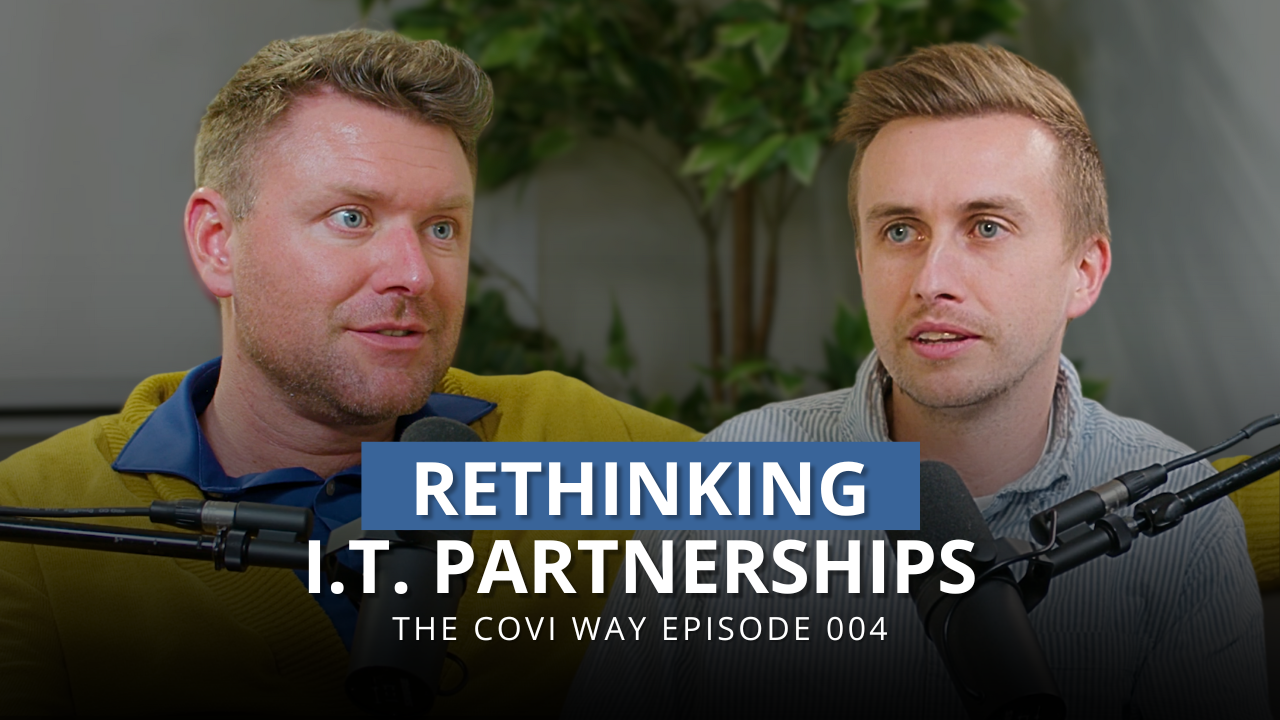
In this episode of The COVI Way, host Cody Lents (VP of Sales at COVI) sits down with Luke McDaniel, Sales Account Manager at COVI, to explore what it looks like when client relationships move beyond break/fix support into long-term, purpose-aligned partnerships.
Luke shares lessons from his time in fast-paced technical account management—including high-stakes work with Salesforce—and how those experiences shape his people-first approach today. They break down the importance of empathy, education, and proactive thinking when stewarding technology for organizations, plus how the COVI team intentionally builds trust to shift clients from reactive to strategic.
Whether you’re a tech leader, business executive, or just trying to navigate your own IT headaches, this episode brings clarity to the often murky world of IT consulting—and why strategy should always come before software.
Key Quotes:
-
“I want to be a partner, not just a salesperson.”
-
“Most clients come to us thinking they have one problem. What they really need is a plan.”
-
“When leaders realize they can take off the ‘IT expert’ hat, you can see the relief.”
-
“Thoughtful responses win over quick ones—every single time.”
-
“We don’t just want to be another vendor. We want to feel like your internal team.”
Connect with COVI:
Instagram | Facebook | Website | FREE IT Strategy Analysis
Links to The COVI Way Podcast
YouTube | Apple Podcasts | Spotify
Episode Transcript
Cody: Client relationships with COVI’s newest team member, sales account manager, Luke McDaniel. He spent years in technical account management, putting out fires, managing issues, and navigating complex technical requirements. Now he’s flipped that script, and at COVI, is helping clients move from a reactive posture to a proactive, purpose-aligned partnership.
Cody: Luke, welcome to The COVI Way. Thanks for coming today. How are you feeling?
Luke: I’m feeling good. I’m excited for our conversation. Should be an exciting one. So thanks for having me.
Cody: You’re welcome. I’m excited, too. I’m hoping to glean some new insights that I really need to be successful here. Do you mind starting by giving kind of an overview of what technical account management has been at the organization you’ve been at?
Luke: Yeah, absolutely. So really for the past eight or nine years, I’ve done a little bit of everything from really small SMB companies across different industries to really specific enterprise, health and life science, account management when I was at Salesforce. The work that I was doing was everything from really quick ticket, quick sale, really quick week-long sales process to things that were drawn out to six months to beyond a year, working with our stakeholders to come to a solution. So I’ve had some really good experience of really short to really long processes and kind of everything in between.
Cody: Do you have some examples or could you just maybe summarize what you learned along the way and if there was something different between those quicker turn organizations that were like that smaller business week-long engagements compared to that more month-long or months-long engagements at Salesforce?
Luke: Yeah, definitely the shorter ones. They’re very transactional. You meet with them on Monday for the first time, understand as much as you can quickly. Maybe on Tuesday or Wednesday, you’re setting up a demo to go through your solution. Maybe by Thursday, Friday or early the next week, you’re presenting the actual solution, and it’s either getting a yes or no. So they’re extremely quick software solutions and it doesn’t give you a lot of time to get to know who you’re working with or the depth of the problems that you’re trying to solve.
That was definitely more so the case on an enterprise when you’re working with large companies and doing really deep problem solving across the board in multiple different parts of the business. When I’m working with SMBs, I primarily was working with one person solving one problem. In enterprise you’re typically working with, you might have a room of 10 stakeholders all from different departments, bringing different challenges to the table. And we’re trying to consolidate and figure out how we can solve multiple problems all at once or how one solution can kind of apply to multiple different areas of the business. It’s very different in getting to know the people that we’re working with.
Cody: So, beyond, because I heard you say this, beyond the, you don’t get to know the people very well or their problems as deep as you would or could. Are there any other shortcomings or traps that might happen with that kind of quick turn? The speed and pace you’re running?
Luke: Yeah, definitely with the short term solutions. It is short sighted. So you figure out how to solve this one problem. And then when they do sign on, oftentimes after the sale, they’re coming back and saying like, hey, what about this? Why didn’t we think about solving these other problems that this software could have touched as well? And so you’re left kind of coming back to the drawing board and saying, oh, we should have thought about that in the beginning process, which happens sometimes, not hopefully not too frequently, but it definitely did happen.
Cody: Knowing that you’ve been here for three months or so now and knowing that by design in our DNA from when Chip founded COVI and then by design whenever I operationalized the way Chip was doing things over the last decade from a sales and account management perspective, what have you discovered is different here? I never worked in a technical background in any of my other sales or account management positions in the past at other organizations. And so I literally don’t know the difference between what you’re describing and what we’re doing. I know that it’s different, but I don’t know what your perspective is like, how do you define that differentiation?
Luke: Yeah, it is a little bit different in that previously we were just trying to solve one problem at a time and coming up with one solution to solve that problem. So it’s very pointed to that one solution. Whereas I think what I’m most excited about and what I’ve seen in conversations I’ve been a part of with you, with our clients is it’s much more of a partnership. Our clients are coming to us and saying, “Hey, we don’t actually know if this is the most important problem to solve.” Sometimes they say, “Hey, we’re having issues with this. We would like to solve it.” Sometimes we’re bringing ideas to the table, but it’s much more about a partnership than it is a, we’re just trying to solve one challenge for you.
So it’s a little bit different in that we have to think about their long term and not just one challenge, but multiple challenges and align how IT can actually match and mirror their goals and support their goals that they have across the business and not just for one department.
Cody: In your other jobs, did you even know the goals or did you know that you knew all the goals?
Luke: Yeah, sometimes. That definitely came up where we would try to solve challenges for one department. So as an example, I was working in medical device and we were helping quality managers get their devices to market. And so oftentimes quality managers would be focusing on how do we get everything in order from a software perspective to get all of our quality documents in place so that we can submit it to the FDA. And that was their one challenge. Like how do we consolidate all those documents in one place?
The CEO, president, I mean, obviously they want to get their devices to market, but they’re thinking much more broad than that. Like how do we raise money and how do we innovate on some of our other products that are already existing? Those are things that the software can touch, but we oftentimes would miss the goals from a holistic perspective. We were just focused on how do we solve this one little thing at a time.
Cody: Because you only had so much time.
Luke: Yeah. You have a short amount of time to get to a decision. And it would have been great to pull in additional stakeholders to figure out what’s most important to them as a whole business and how do we solve all of those things, align better with their goals.
Cody: That makes sense. We started talking in like early fall of last year in your hiring process. And during the interviews, I know we talked a lot about what I believe made us different and how we did things either procedurally or philosophically different on the account management side. We call it stewardship instead of account management internally so that it helps us understand that like, hey, we’re stewarding technology, we’re stewarding IT finance. What about those conversations and that differentiation made you want to jump on our team?
Luke: So I think switching the mindset from just a salesperson to what we call a steward is something that really spoke to me, I guess, in the interview process because I want to just build relationships. I love coming alongside teams and actually having a long-term, long-lasting relationship where I feel like I’m a partner and not just somebody who’s going to meet with them and sell them something. I love seeing the long-lasting impacts of the work that I’m doing. And I often didn’t get to see that just on the sales side as we would sell something and then you’d get moved over to client success. And then we would never hear about it again.
Whereas I’m really excited at COVI to have that longer lasting relationship and see the impact of the work we’re doing.
Cody: I’ve experienced with some of our more consultative partnerships where we’re paying someone to assist us, where they have like a salesperson or I’ve heard them call them a contract manager. And so they run it until the contracts close and then it goes off to account management or customer success or whatever verbiage they call it. I personally have never enjoyed that experience because I feel like I have to do a lot of repetition after handoff. Did you ever get any feedback about that type of situation? Maybe not specifically that, but when you were doing the customer success handoff?
Luke: Yeah, obviously the goal is to give as good of a handoff as you can, but when you’re doing multiple sales that are super quick, it’s really hard to give as much information as possible. So we oftentimes would hear from clients that would say, “Hey, I already told you, I already told the sales guy this, why am I repeating it?” And so it kind of builds a little bit of distrust, like, “Hey, I just signed on with you. You guys should know across the board what our problem is and how to solve it.”
Cody: And you didn’t have to solve those complaints because you had already handed off, right?
Luke: So a lot of times, our client success team would hear those complaints and come back and we did our best to do a good handoff, but you can only do as good enough job in those situations.
Cody: Especially if it’s written down 2D communication and not in a meeting or if you’re in a meeting with 3D communication and you don’t do good notes to kick it away, then there, whether it’s employee turnover or just forgetfulness, you still have a lot of propensity for human error.
Luke: Absolutely.
Cody: The COVI Way, the name of the podcast, it came off of some trendy, spiffy verbiage from some marketing endeavor we did back in the day. I don’t even remember, but it was meant to basically be like, we’re not just gonna rush out there and try to get your business and onboard you and get you paying a monthly retainer as fast as possible. It was, hey, we have to do a really comprehensive assessment and make sure that we have a good plan and that we’re the right fit. Now we do as much as we can to make sure that we’re gonna be able to solve problems and pain and challenges and everything before we even get to that phase, but the assessment’s what confirms that we’re right.
The COVI Way phrase has evolved since then to this podcast and to other areas of marketing, but that entire experience, the COVI way, whether it’s the people first culture internally that transcends to a people first culture in the way we do help desk support, or even the way that we calibrate our cybersecurity and educate on it so that it’s not just like, “Hey, you can’t do these things.” It’s, “You can’t do these things because…” Those are all things that we talked about. Can you tell me how that changes the way you wake up to go to work every day? Whether that’s energizing, whether it’s more stressful, like whatever it is for you. I know you said you get to see the fruits of your labor basically was one of the reasons you wanted to jump on the team. What about the day to day when it’s like, maybe it’s a bad day. You got like five complaints to deal with or, you ran your car into a tree and now you gotta do my appointments without even knowing what’s going on or something like that.
Luke: I think it’s exciting because you wake up each day with a new challenge, but you also get to help our clients understand what the challenge is and educate them a little bit. Some of the conversations I guess we’ve already had with clients, I’ve seen kind of the light in their eye when they start to understand what the challenge is and how we’re going to solve it. They kind of lean in a little bit. They’re like, “Oh, tell me more. I’m excited about this.”
So I am most excited about those types of conversations with leaders who begin to understand like, hey, sometimes IT can be a pain and they can say, “Hey, this is not something I want to focus on.” But when they start to switch that mindset a little bit of, it’s not just a pain, not just something that we’re trying to play whack-a-mole with, but it’s something that we can use to leverage to better grow our business. Like those are fun conversations to have. So I wake up excited to have those. Not every day do we get to have those, but as much as we can.
Cody: Quite a few. Yeah. It is exciting. You mentioned mindset. How do you help a leader of an organization who’s so used to IT being all about a technology solution like the software itself or the support, the day to day support. How do you help them adjust to the more strategic approach that you’re describing? Because it sounds like once they get it, they’re bought in, they’re leaning forward. I actually never noticed that. So that’s new information for me that I’m super excited about. But that’s like a moment in time.
So how do you do that? Where it’s more like when we’re on the partnership from a partnership level where it’s like they understand that we are solving a help desk to get here and there. But we’re looking at the entire holistic IT ecosystem in a way that is strategic instead of just like this one little problem, this one little time, especially when we get to the meetings that you’re talking about. And we’re looking at like, hey, we need to make some big initiatives and invest in some big things. How do we know that it’s the right big thing? And how do we get them to bring their brain space of, we’re talking strategy, not tech to the table?
Luke: I think it’s definitely a, I hate using the word, like it’s a cultural thing, but definitely at COVI, like it feels like a cultural thing, because it’s not just our conversations, like it is how we approach support tickets too. So I’ve noticed a lot of times when there are support issues, tickets that come in that we need to resolve, our team does a really good job of explaining the actual issue and how we’re going to solve them and giving them really good explanations. And that goes a long way.
But beyond that, like for the actual strategic part of the business that we’re trying to solve for, it comes a little bit at a time. A lot of people will probably come in and think of it as just solving these one little issues. I think the way that we approach our conversations is we give them our understanding or some of our assumptions that we’re bringing to the table and saying, “Hey, based on what we know so far, these are the things that we imagine are most important to you. And these are the areas that we should be focused on and how we’re going to begin to solve them for you.”
It’s not just saying, “Hey, you’ve got a firewall that’s outdated. Let’s put that in.” And that would have been a very transactional thing that we could do. But it’s more about, “Hey, these things are important business challenges. These are the issues that should be priority for you right now. And the things that we believe that should be priority for you like longer term.” And when we start to have those conversations, it becomes a lot more natural over time. I’m sure you’ve had conversations with people that have started off maybe feeling transactional, but over time they get the idea of how they can work with COVI and how they can leverage us better, not just from a transactional fix these little issues, but how we can work with them to innovate over the longer term.
Cody: I usually say it takes 90 to 180 days before we hit stride is the phrase I always use, but it’s more we’re confident that we understand enough about what you do, if not most of what you do so that we can advise with accuracy and appropriateness. And on a similar timetable is usually where we’ve established that trust and or mindset shift where they’re like, “Oh, when I have a strategy question that impacts technology, I need to bring you to the table or I just go straight to you” or whatever the system would be in that situation that’ll be client specific.
Thinking about your past again and also like other IT services organizations and IT consulting organizations like ours, a traditional vendor like that prioritizes low touch efficient processes and low touch efficient experiences, leveraging service level agreements or SLAs that are usually one way in the provider’s favor. And they do that not necessarily to be a bully the way that that sounds when I just say it in a vacuum like that, they do it so that they can control the experience and they can control the pricing and they can be operationally efficient and like all good things. But what have you noticed is different about the way we do things at COVI? Not that we don’t use SLAs or anything like that, but just from a philosophical perspective, what have you noticed is different here?
Luke: I would say I’m excited because I don’t think we buy into the whole vanity metric type of thing where a lot of companies say SLAs are the most important metric or response time specifically is the most important metric. And those are definitely important. Those are definitely things we should monitor and track and make sure we’re improving over time. But SLAs just are really focused around how quick did you respond? And I think what’s more important is that we’re measuring the partnership because partnership measures like actual success.
And so I think that’s something that I have seen at COVI is that we do measure and we do track things and we want to improve some of those things. But what’s most important is the partnership. So we don’t want to have a quick response time come at the expense of giving a thorough and thoughtful response that’s going to be meaningful to the stakeholder.
Cody: That’s on our level. Does that transcend down to like a help desk situation?
Luke: Yeah, absolutely. I’ve seen, and we hear all the time on our client meetings where somebody will say like, “Oh, we got a really thoughtful response. I didn’t really understand how they resolved this at first or how they were going to resolve it at first, but Ethan gave me an amazing response and I actually understand what we’re doing now.” A lot of times with IT challenges, people don’t really know what’s happening on the back end.
Cody: I don’t understand all the time what we’re doing on the back.
Luke: I don’t either anymore. So, I mean, just the thoughtfulness goes a really long way and the thoroughness of our responses and how we take care of the customer and bring them along for the journey and not just say, “Hey, we’re going to take care of it” and take care of it on the back end, send them on their way.
Cody: Of that kind of experience and the experiences you’ve described over the last few minutes, how do you think a leader of an organization feels when they realize that they don’t have to be a technology expert? If you’re listening and not watching, I’m doing air quotes because we know that somebody that’s a CEO or a CFO is an expert in other things and they’re just wearing many hats and this would be one of the other hats they have to put on. And when they realize they can take that hat off, how do you think that they feel?
Luke: I would definitely say relief. I feel like a lot of leaders when there’s a challenge that comes up—and maybe I’ve seen it on calls and heard it on calls—where they start off a little bit frustrated, right? There’s a problem that we’re trying to solve and we don’t understand how to solve it or we don’t understand why this is a problem. When we can do a really good job of coming alongside them and one, empathize, “Hey, we understand this is a challenge, we understand the impact of this challenge” and then help them understand that we can be a trusted advisor.
It’s another one of those kind of buzzwordy things. But it is super important to come alongside them as a trusted advisor for them to say, “COVI has this. COVI has got our backs. They know what needs to be done and they’ll help us understand the whole situation and how to solve it.” You can kind of see them sit back or relax a little bit because they’re like, “Okay, COVI is gonna help us through this.”
Cody: Something that we talk about internally is that we want to create the closest thing to an internal IT resource or department at the outsourced dollar amount or pricing and we know we’re not gonna be able to replicate it to a T because there’s just things you can do internally that we can’t handle as an outsource third party. But I think that you have something there where it’s like the moment that they realize like, “Oh, this basically is like another department to my organization.”
Yeah. And then they can take that hat off. And then that anxiety or that pressure goes away, that relief comes in and then they just say, “It’s just an email away. I know I’m going to hear back in 36 to 48 hours minimum, if it’s an emergency, I’ll make a call and I know I’ll get a same day response from a Luke or a Cody or whatever.” So that’s a good point.
A lot of organizations are navigating technology with the mindset of like IT or especially cybersecurity is the necessary evil. I have to have it; I have to have technology to function; I have to have cybersecurity to have technology; but it’s really just like this gross, “Man, I hate that” or “I hate having my health insurance that doesn’t cover anything” sort of thing. How do you see either the way that we work at COVI with some of our internal processes that are unto client-specific activities, or just in your meetings that you’ve had or been a part of with me, how do you see us helping adjust that mindset to like, “Oh, no, IT is a productivity enhancer, a growth engine, it’s less of a cost and more of an investment if you’re doing it appropriately.” How does that flesh itself out in reality?
Luke: In reality, it’s got to come slowly and surely, and you’ve got to build that trust over time. There are probably a lot of business leaders who have that mindset of, IT is this line item, this necessary evil kind of line item that we have to do so that our people have computers or something that work.
But over time, if we bring ideas to the table and say, “Hey, we know you’re doing this. Have you thought about also doing this because it aligns with your goals?” If we can do that and we can make it happen and then they can see, “Hey, COVI actually is bringing some really innovative ideas that will help us grow,” it starts to shift their mindset a little bit from IT just being this necessary evil to actually having a seat at the executive table where IT is a part of their broader strategy.
Cody: In a similar line of thought, what one outdated or incorrect belief that a lot of business leaders have—what’s the top one that you can think of that you would wish they would forget about?
Luke: I think a lot of leaders think IT is working when they don’t hear about it because problems are not coming up. They’re not hearing about the fires that they need to be putting out. And while that’s somewhat true, like you don’t want to have your people all the time screaming about all the IT and technological problems that they’re having, it should go beyond that. Business leaders need to start thinking about how to leverage technology to accelerate them to their goals and not just view it as something that is getting in the way if they don’t do it right.
Cody: So it’s like in the 90s, we were begging people to put computer systems in. And then now it’s just like if you don’t have a computer, you’re not working like unless you’re in the dirt, basically. And I don’t mean that in a derogatory way, I mean, like working with your hands in the dirt. But the reality you’re talking about is like, yeah, that’s true. You have to have your tools. You have to use your tools just like you would in a tool belt. But now it’s usually in a laptop or whatever form you have.
And then you’re saying on top of that, we need like some strategic direction and some innovative pieces that is like, “Hey, good job swinging a hammer. Did you know we can do a compressed air or air compressed nailer and be three times as productive or have one less crew member that’s nailing that could handle cleanup and we could close the job faster.” You can tell I have a history as a roofer.
Luke: It’s kind of twofold. Reactive is super important, but proactive is also important.
Cody: That’s a good point.
Luke: Most IT companies are kind of doing that, but a lot of business leaders need to be just thinking about the future, the proactive. How can we innovate? How can we make these things better?
Cody: And the same way that we’re thinking about, what’s our top three strategic initiatives as a company for 2026, we can think, okay, what’s our top three for IT or tech. And the favorite puzzle is looking at those and being like, why don’t they support each other? Like if your strategic goal is to increase employee retention by 50% next year, we should probably find out what technology’s role is in making employees happy or not happy. Or if it’s to increase sales by 150% next year, we should figure out what sort of technology roadblocks are impacting your salespeople.
Luke: It’s a good question. It’s just, what are your goals and how is technology currently supporting you in that? Or how do you plan on using technology to support that for everything.
Cody: And that makes a lot of sense. In the idea of innovation, what’s the thing for 2025 you’re most excited about to get out in front of clients to help them?
Luke: I’m still learning. I’ve still got lots to learn. But I think the things that I’m hearing about the most that I’m most excited about is probably just AI and automation and connecting tools that can help accelerate their business. I feel like all the time we are hearing AI being thrown around and automation and there’s just an endless amount of possibilities for it that I’m just excited to learn and see how we can apply it better for our clients.
Cody: Yeah, you know how we use it here. So getting to see how that can transcend down to a client specific situation. We only have a few that are heavily dabbling in that space and the rest are hobbyists with just their little GPT in their pockets.
For someone who may be listening or watching today, that is navigating the confusion that comes with all the noise of technology and the fast-paced change that comes. Like it doesn’t matter what you’re looking at. It just changes so quickly. What one first step could you give them to be like, “Hey, take this step and you’ll start down the right path if you go there.”
Luke: I think the one thing that I would like maybe encourage business leaders who are trying to take a first step towards maybe just bettering their technology in their company or just moving in that direction if they feel like they’re maybe outdated or just don’t know where to begin is one, it’s just super important to ask your team, “What’s working well and what’s not?” And then kind of like we previously said, “What are our goals for the next year and how is technology supporting us or where’s technology getting in the way from us achieving those goals?” Just asking those obvious questions will give you a good place to start.
Cody: Yeah, it is. That’s part of our assessment actually. So that does make a lot of sense. What scares you the most about stewarding basically the keys of the kingdom? When technology fails, usually organizations come to a stop. So what’s the scariest thing for you that you’re starting to figure out over the short time you’ve been here?
Luke: I think maybe the scariest thing is just making the right recommendation at the right time, the most impactful recommendation at the right time. With most companies, there’s always five to 10 challenges you can solve all at once. So part of my plan is just to do the best job I can do to better understand what are the goals and how do the projects that we’re putting in front of our clients best align to those goals? So that’s something I’m gonna be thinking about and bringing up in conversations with clients is, is this the best next thing to do for your business and how will it impact you?
Cody: Yep. So that’s a good answer. Bonus points, stars. Nice. And that leads us towards the end. Every episode, we do a tech tip of the day. And today I’ve decided I’m going to put you on the spot and ask you a question and let you do the tech tip. So the question is what’s one practical piece of advice that you give like repetitively that just seems to be successful every time for a client.
Luke: I think one thing just to keep in mind is just focusing on responsiveness. Responsiveness doesn’t always equal relevance. It’s super important to get responsiveness to get a response. But if it’s not actually driving to the root cause of issues, especially, we’ve seen so many issues that have bubbled up and come in through tickets that we easily could have just responded and said, “Hey, here’s your quick fix.” But I’ve kind of learned from our team who do a really good job of understanding what the actual root cause is in solving that so it doesn’t become an issue for other team members. So it’s something to think about is, am I getting a quick response or am I getting the most thorough, thoughtful response that’s gonna help me solve my actual challenge?
Cody: That’s a good one. And that’s your tech tip. Thanks for joining us today. At The COVI Way, we just dove into your past a little bit, went from Luke the firefighter to Luke the strategist and hopefully we gleaned a little bit of knowledge around what makes IT more valuable to an organization and the things that we can think about that are a little bit more atypical to what you think about when you think of IT or tech in a vacuum. So thanks for joining us today.