Creating Meaningful Change and Financial Literacy with Eric Zhang
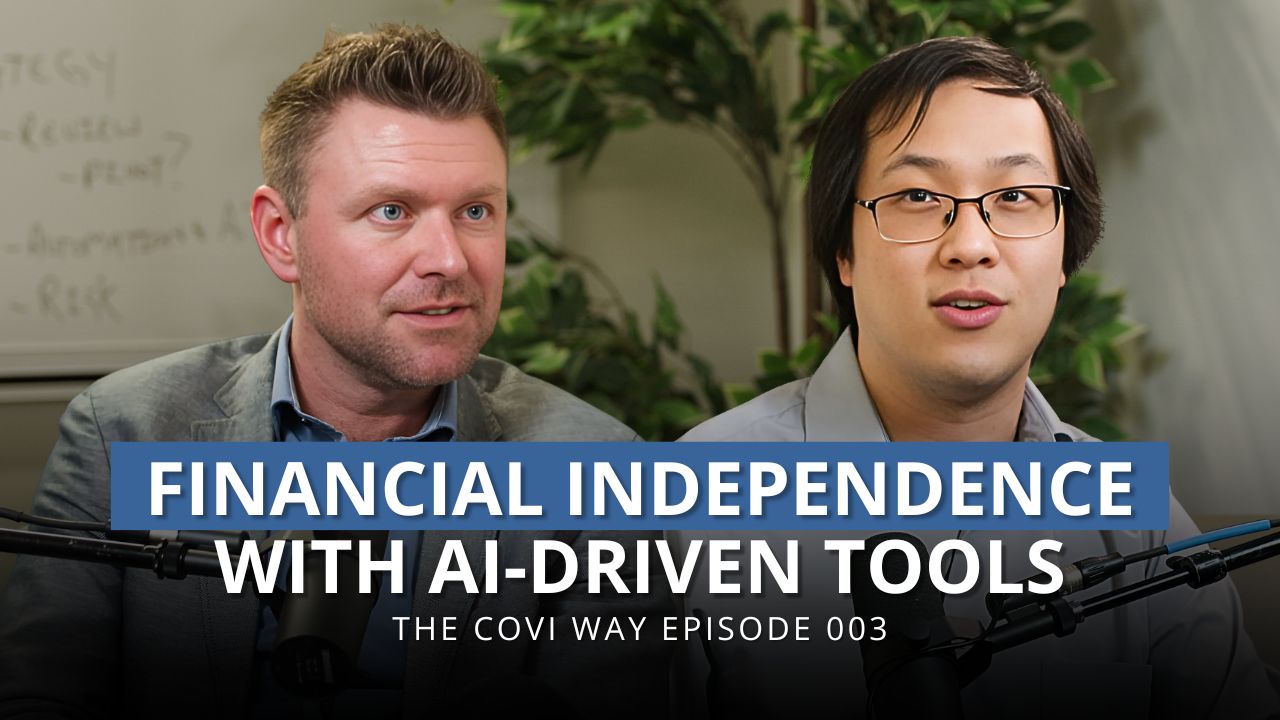
In the latest episode of The COVI Way podcast, host Cody Lents sits down with Eric Zhang, Product Manager at WiseFi, to explore how AI-driven solutions can help individuals achieve financial independence. Eric shares his personal journey that led him to financial coaching and eventually to WiseFi, a platform dedicated to helping a million people reach financial freedom by providing forward-looking financial planning rather than backward-focused budgeting.
What sets WiseFi apart is its approach to financial literacy through actionable, tactical strategies rather than generic advice. The platform helps users understand how their current spending decisions impact their long-term financial goals, creating personalized plans for debt management and retirement. As Eric explains, financial independence isn’t about waiting until 65 to retire, but about having the freedom to do what you want, with whom you want, without the constraints of a full-time job you don’t necessarily want.
The conversation also explores how AI enhances both the user experience and WiseFi’s internal operations. From personalized financial recommendations to automated customer support, AI helps the company scale its impact while maintaining a lean team. As financial technology continues to evolve rapidly, WiseFi remains focused on its mission to create meaningful change by showing people tangible paths to their ideal life – whether that’s through their consumer app or their enterprise solution for organizations wanting to support their employees’ financial wellbeing.
https://youtu.be/NUZ7sPVK2Eg?si=nO2Iao64D1dUu4bb
Episode Summary:
WiseFi’s Eric Zhang joins The Covi Way to explore how AI is revolutionizing financial planning. From debt payoff to early retirement, WiseFi builds personalized, forward-facing plans to help users gain clarity and reach financial freedom faster. Whether you’re managing a household or leading a large organization, this episode is packed with hope and practical solutions.
Key Quotes:
-
“Financial independence means doing what you want, with who you want, without being stuck in a job you hate.”
-
“Most budgeting apps look backward. We help people plan forward—and that changes everything.”
-
“Our users don’t just track spending—they build strategy.”
-
“AI helps us deliver customized coaching at scale, not just canned advice.”
-
“We’re not just changing finances—we’re restoring confidence.”
Connect with COVI:
Instagram | Facebook | Website | FREE IT Strategy Analysis
Links to The COVI Way Podcast
YouTube | Apple Podcasts | Spotify
Episode Transcript
Cody: Welcome to The COVI Way, the podcast where we break down the intersection of people and technology because IT isn’t just about fixing problems. It’s about enabling people to do their best work. I’m your host, Cody Lents, the VP of Sales at COVI. Today we’re diving into innovative financial solutions with our guest, Eric Zhang from WiseFi. Eric is the product manager at WiseFi, a company dedicated to helping individuals achieve financial freedom through AI-driven solutions with a background in product management and a passion for financial technology. Eric plays a pivotal role in developing tools that simplify complex financial decisions. Welcome to The COVI Way podcast.
Eric: I’m doing great. Thanks for having me on the show.
Cody: Eric, WiseFi is on a mission to help a million people, and this would be individual people, reach financial independence. Could you tell me the inspiration behind this and what empowers your team to get up every day in the morning and go execute the work to get there?
Eric: Yes, I love this question. I’m going to start with my personal inspiration and then talk about the company’s inspiration as well. So on my side, it started back in college. I thought, okay, I need to go get a high paying job and graduate and work 40 years of my life. And then after that, I’ll be happy and can retire. After that thought process, I was realizing there’s probably a better way to live life or a more fulfilling way to live life. And so I went down this journey of what could financial independence mean for me.
As I was doing a lot of research, I was interning and working at different tech companies and figuring out what does that process look like to be financially independent? What does that definition look like? Once I figured that out for myself, I realized that it’s not something that’s commonly taught in any piece of our society. Like if you look at financial literacy or just growing up, you don’t really hear about going to live the life you want to live without any expectation of working this typical career. And so I wanted to help empower other people to do that.
A couple of years ago, I became a financial coach and I started coaching other people on how to go down the same journey. And then I partnered with WiseFi to figure out how can we scale this to really make an impact on millions of people in the country. I love helping people live their ideal life. When I define financial independence, it’s being able to do what you want with who you want without having the constraints of a full-time job you don’t necessarily want.
When you transition to the company side, we saw there was a gap in the market. There’s a lot of opportunity for people who need financial literacy as well as financial support. Now, if you look at some of the stats, like we just crossed $18 trillion of consumer debt, inflation’s at all time high. We have people at this stage in life where you have so much access to resources and learning and online education, but you still have these fundamental problems of “I can’t manage my money. I don’t know what financial independence means. I don’t feel like I can ever buy a house or I can even be financially independent.” So how do we fix that from a systems perspective?
Wanting to solve that big hairy societal problem is what gets us really going. And that comes from this desire to want to help people and have an impact to build this movement of you can go live the life you want.
Cody: You have the passion for the actual outcome.
Eric: Exactly. Because I’ve seen the payoff. Like when people have that aha moment, they’re like, I never realized… We have testimonials of people saying, “I never thought about this.” And they were crying because they’re like, “I never thought this was possible. And you’ve laid it out for me. And I now have hope in my life because I can see how this could work for myself. And this is the first time I’ve ever felt confident in my future, my finances.” And this is such an amazing, empowering thing. When you see that in a couple of people, you’re like, okay, this is really cool. Let’s make this work for the rest of the world.
Cody: That’s exciting. I was already on my task list to demo or take a dive at the platform. Now I’m thinking maybe we should talk and see what I need to be doing. I know even with myself, managing finances is hairy and complex. How does the company use AI to help solve those problems for your users?
Eric: AI is a big buzzword. Let me break it down into a couple different sections. There’s like AI AI, there’s machine learning, and then there’s just logic. Let me talk about how WiseFi solves the problem. And then I’ll kind of layer in how we do that with those different types of applications.
The problem that we noticed was that budgeting apps, personal finance apps, they all look backwards. They’re like, okay, well, what did you spend last month? Create an arbitrary budget for what you probably should spend. And then if you go over that, oops, there’s no way to fix it. You just made a mistake. The way we look at it, that’s like driving your car, looking in the rear view mirror the whole time.
Versus we want to drive the car looking at the front windshield. And the way to do that is to say, okay, how do my choices impact my financial future? If I were to say, eating out and spending $500 on takeout every single month delays my ability to reach financial independence by 10 years, do I want to make that decision? You’re still empowered to do whatever you want, but you now have the ability, the clarity to say, okay, this is how my decisions impact that future. Now, what do I want to do?
So to answer your question, WiseFi pulls all of your data in, lets you connect your accounts, secure your transactions, see your balances, and then create this plan that says, if I follow this step-by-step plan, I spend this much, I earn this much, I save this much, I invest this much at this rate, and I pay off my debt on this plan, what does my future look like? And now, as I tweak things, what does that do to my future?
So all of that isn’t AI. It’s just our algorithm saying, look, here’s the best payoff method. Here’s our calculations. Here are our assumptions. Let’s do this. And where AI can come in is, okay, I have extra questions. I don’t know how to fix what I’m doing wrong right now. I want this AI tool to help motivate me or notify me when I’m doing bad decisions and help me correct those and make more impactful decisions. How do I do that?
So those are the things that AI can start learning because we have the data to say, this is the user’s objectives, this is their goal. How do we get them to that objective faster? And then you can optimize and send that type of interaction. So the short answer is we use a lot of the algorithms to help people create those calculations and plans for themselves, but then the AI can help with additional customer support as well as additional planning, tracking, notifications, all of those pieces.
Cody: I know as being a member of the generation that graduated with intense amounts of student loan debt that two of the primary priorities when it comes to finance management for people, especially people I know, are retirement planning and debt payoff. So how does the platform assist those users in accelerating those things, the retirement and the debt?
Eric: So let’s talk about debt and then I’ll talk about retirement. On the debt side, our algorithm prioritizes your debt based on the best order to pay it off. Whether that’s I want to pay the least amount of interest, I want to pay off my debt the fastest, I want to have the least amount of debt, like you do the snowball or the avalanche or whatever method you want. We can customize that in the algorithm to say, look, okay, if you follow this exact step, this is the best path for you to pay the least amount of interest. And by the way, you’re still able to reach financial independence at the desired date of 50 or whatever it is.
Great. My ducks are all in a row. I’ve found my debt payoff strategy, found my independence strategy, my investing strategy, everything’s all in a row, I’m good to go. So that’s how we help people on the debt side because sometimes it’s hard to use an online calculator and put it all in and figure out what to do. We just automate all that for you. What do you want to do, what’s the objective? Let’s make you the best plan to reach that objective.
Now on the retirement planning side, there’s a lot to unpack here, but I’ll keep it at a higher level for now. There is the retirement planning from a just pure, I want to reach financial independence. So what does that mean? Okay, I need a million dollars to pay me 4% of that per year to never run out of money. Great, I need $40,000 a year of expenses. Okay, when do I get a million dollars in my piggy bank or whatever to be able to afford that lifestyle? Great, we can create the projections that show that piece.
But if you’re like, oh, I want estate planning, I want tax planning, I want to do that thing, we can partner with other people to provide that. But we’re just trying to get people really excited about living their ideal life. People start to think about retirement as, I have to be 65. Well, what if you took a gap year and just spent the year traveling around the world and doing the things you really wanted to do? What if you could switch to a part-time job that’s just as fulfilling, doing something that you’re really passionate about and still fulfill your goal of retiring at 65? What if you could just take no job and volunteer and do other things that you’ve never thought were possible because you didn’t think you had the money to? How can we empower you to figure out that if this is possible, what is the plan and the steps to do that and then go help you execute?
So it’s not really retirement planning in that sense, like the traditional financial planning, but it helps people figure out what do they need to reach their desired ideal life.
Cody: Yeah, and I love that phrase to see and reach your ideal life. Something that I don’t think we hear about enough or maybe at all, especially growing up in at least our culture here.
I know that I’ve brought myself up a few times and I know some of the problems that I encountered, especially at 24 and 25 when I first got out of college, but what financial pitfalls do you see commonly with your user base or the people that you’ve consulted with in the past? And then how is WiseFi doing the job of helping to remediate those pitfalls?
Eric: Two big pitfalls we see with new users. One is how to set up a budget. And number two is handling different life scenarios. So let me go through each of those.
For setting up a budget, the most common one is like, what do I do? I don’t know what’s going on. I don’t even track my money. I just know it goes in and out. Help me create a budget. And for us, it goes back to that rear view mirror kind of perspective. What’s your goal? You have to start with what’s your objective. And then we can back calculate what does it take to get there? And if the answer is I can’t make it work, like, okay, in order for me to reach financial independence at 50, I have to either earn $5,000 more a month in income or I have to reduce my expenses by that amount. There’s no other way to make it work.
So then how do we reposition our goals with that end objective in mind and make the plan work for what you need? So that’s the very first pitfall, which is not knowing how to budget. And our answer is, well, let’s start with the end goal in mind, work backwards. And if there’s a discrepancy or something you can’t solve, that’s the thing you should be solving. It’s not like, go spend less at Starbucks each month when you’re $5,000 short of being able to reach your goals.
Okay, maybe I need to do a career change. Maybe this is a five-year plan that I can do for the next 10 to 15 years. But then after that, I’m golden because now I can be 45, have the financial independence, be working the job that I love and now everything’s good versus feeling like I’m 25 and nothing’s working out. I have no future and there’s no path forward. That’s the scenario we’re trying to avoid for people.
On the life events side, there’s very common ones like, oh, I want to buy a house. How do I do that? Can I afford that? There’s, I’m getting windfall money as an inheritance. There’s, I want to buy a car, can I afford that? I want to change jobs, can I afford that? And these what-if scenarios is a really powerful feature we built into the tool.
So not only can you create your plan that says, great, you can set it and forget it. You’ve done the math and the calculations, everything looks good. Just follow the marching orders every single month. That’s one side of it. But then there’s this other side of like, what if I want to buy a house, but can I afford it? Well, let’s find out. Let’s create a copy of your plan and a draft scenario where you can just play around with all the numbers. If my rent increases to $3,000 a month, because I have a mortgage and interest and all this stuff, in order to increase that amount, I have to either increase my income or decrease my expenses. So let me just move the money around to see how can I make this work? And then what does that do to my financial independence date or my goals?
And if I’m happy with that result, great, let’s save it. And that’s your marching order, go execute on that plan. But if you’re like, man, I don’t really like this. Something’s not working out. Maybe I’ll come back to it. We can save all of these copies and you can play around with all these different draft scenarios to plan out these different unexpected life events and just see what makes more sense for me and for my goals.
Cody: So the entire product and the team are generating a lot of hope and that vision casting for that ideal life. And I know we talked about AI a minute ago. How is AI, like the details of how AI is helping to augment that user experience for your people?
Eric: For the user side, we’re still in that data collection portion. There’s a lot of data to be able to train the AI model on how to best help the user. And the way we train that is through a lot of the customer support tickets. So people will come in, hey, what do I do? Like, where can I improve? And we pull on other account formation data. We have all of our backlog of previous support tickets as well as help articles.
We just released a new feature called strategies, which is like very tactical strategies to improve your budget. It’s not like, oh, spend less money on Starbucks. It’s like, no, here’s how to not spend any money on food for the whole month. And like, it’s very tactical, very step-by-step. So we utilize all the data that we’ve collected, both from the user, their goals, their information, as well as previous information we’ve documented to try to provide this AI customized solution that’s like, okay, you’re trying to save more money here. Here are the actual suggestions that we would give based on all the things that you’ve told us versus the general ChatGPT. Oh, here’s 10 ways to save money on dining out.
So that’s one of the biggest ways that we want to leverage that piece. But the question is, is it necessary or can we do that with just a lot of logic and piecing it together through different methods? Another way that we can implement it is through the data and the projection. So there’s a lot of forecasting, like, you consistently spend money every month in this behavior. I always go to the gas station and get my morning bagel. Okay, what if we substitute that habit with something else that still gets you that same fix, but is a different way to help you save money. That’s not intrusive of like just telling you like the coach that’s just yelling at you. It’s more like, here’s another alternative that can still get you the same result for less. Can we do that instead?
So those are kind of the biggest ways we envision AI impacting the user experience. From the business perspective, peeking behind the hood, there’s a couple of ways that we do this on a day-to-day basis. The customer support piece, let me give you some more context. On the product side, I handle a lot of different groups. I go with sales, marketing, customer support, development, QAQC. I am in that full spectrum of understanding the customer’s concerns to selling it, as well as correlating that into product requirements and then changing that for the software itself. So in that role, I’m able to see all the functions and how AI can help us improve all of those functions.
One of the ways that it’s really helpful is through a plugin called Intercom. So our customer support is handled through Intercom. It’s a pretty big company. It’s like anytime you go to any website, the bottom chat corner, like there’s the little window, most of those are Intercom. And you can start to recognize the design. So they embed their chat support to help you with answering questions and having support articles. And they just released a new AI bot called Finn, and I’m not sponsored by them. But the point is that that technology leverages your own data to say, you’ve created 100 support articles that explain step by step blah blah. You’ve answered a thousand support tickets that answer the common questions. We’re going to have your AI chat bot be the first line of defense for all questions based on all the data you’ve already answered.
So because you’ve answered, this is how to cancel your credit card 500 times, it’ll just piece that together and automatically handle those problems. So it’s kind of your first line of defense for customer support. But then also how do we leverage that into customer enhancement? Fighting the fires, it’s I want to give you better, I want to be your AI coach in your pocket. I want to be your Jarvis that’s telling you before you even know what to do, this is the best way to do it. So that’s some of the more tactical things that we do on a business basis to streamline that user experience, but also help us handle the volume of customer support as well as how do we scale with AI in that capacity.
Cody: Do you have a partnership with Intercom for you guys, or is it just leveraging their normal services? As you mentioned earlier about the things you could do with AI, it sounds like you guys are strategizing around that right now. Could you share with us the type of organization and baseline or standardization for the infrastructure you guys use to develop the product that you can deliver internally? So the way that you’re organizing your data and sharing and collaborating in the way that you’re making sure that all of your laptops or phones are able to even function for a team to produce such an innovative solution. What does the backbone infrastructure of the organization look like?
Eric: So without giving away any secrets, of course. Being in a lean startup, you had to be very scrappy. I’ve learned over the years, the more you can make it work, but we’re going to make it work safely and effectively. That’s like the bare minimum.
So for us, when I’m trying to look at across the organization, what levers do I need to pull? I start by saying, well, it’s the business objective. Okay. If I need to go reach out to a thousand social media influencers to go create a marketing campaign, what’s the best way to do that? And for example, one of the things we’ve used is Lemlist. It’s like an automation tool for email outreach. It’s kind of like how HubSpot or other CRMs allow you to do email automation, but at a large scale. And there’s some kind of hacks and workarounds that you can do to send emails to thousands of people without it getting flagged as spam, as well as doing your email automation sequence.
But then also getting all of that data into open range conversion rates, and then optimizing that downstream for how do I do follow-up sequences? And what does that look like for business metrics? What was the success rate of this campaign? So I guess the short answer to your question is you kind of start with the business objective. And then you figure out what tools are necessary to solve that business objective. And then you just kind of go down that rabbit hole for a bit, find one that works. And then if it works, great, and then move on, because you have the time or capacity to scale and fix it because you’re just trying to fight the next fire.
I think another tactical one, meetings. So meetings, for example, utilizing Gemini, ChatGPT to help with writing email copy for your email campaigns or writing or creating imagery for whatever social media or for promotions that you have. Using those systems to, how do I say this? Utilizing those AI systems to augment your current work so that you can focus on the other stuff.
You mentioned in a previous podcast, how do we get to the really important stuff because our time is limited. So in this case, it’s the same thing. How do you automate the things that you don’t necessarily need to spend a lot of time on or aren’t your strength? How do you use AI to supplement your specific unique talents and then go do the stuff that you’re really good at?
The other example of this is meetings. So I don’t know if you’re familiar with like Fathom or other recording tools. So using Fathom, a very simple one, but it’s so much the extra five to 10 minutes of brain power to summarize meeting notes that you either do during the call or after the call, having that just instantaneously there, super great for streamlining operations. And so when you stack like all of those things together, you can imagine if you stack 10 different technologies together, you’ve just created one to two other people on your team that didn’t exist. And so now you can scale very quickly with a lean team.
Cody: When I’m discussing automation or AI with our clients, I use a similar scenario to what you said. I say, we do all this stuff so that the people can focus on the meaningful work, the work that gives them energy, the reason why they want to be here, which is a cultural impact. And then we all know that culture then impacts the output, whether in the nonprofit space, that’s better programming or impact or have the mission or in the business space, better production or operations or service or whatever their primary offering is.
With that in mind, I mean, I feel like since I started, I started tech in college and then took a hiatus. And when I came back, it’s been over almost a decade and a half now. And even from back then in the early 2010s to now, it feels like in the last probably five years, the acceleration of technology even before AI started to accelerate it even faster is insane. And then the cybersecurity that is in pace with that to keep that up or the hackers and the script kiddies that are attacking us as we go along the way, what are you guys doing to keep up with that rapidly changing environment and landscape that’s out there?
Eric: I have a funny story about the cybersecurity, but I’ll come back to that in a second. To keep up with the ever changing landscape, there’s a couple of things. Like I’m subscribed to a lot of different resources. Email newsletters is a great way to just get your finger on the pulse. I’m seeing like hundreds of different solutions come and go every single day, every single week. It’s like, okay, there’s this new technology that does this for AI. Cool. Next week it’s out of business. Okay. What’s the next one? And so it’s overwhelming, but the more you’re just having your finger on the pulse, the more likely you are to find out the ones that are consistent and the ones that can maybe outlive it.
Another way is having really good advisors. So some of our advisors are people who work at OpenAI, for example. We get a finger on the pulse of what’s the newest and greatest. Do we even need this? One of the big questions is do we need AI? Do we need our own LLM? Or can we just bootstrap it ourselves? At what stage do things make the most sense? So the more you can surround yourself with experts who can help you keep that pulse, those would be the two biggest recommendations that I have.
On the rapidly advancing piece, my story is, we were looking into Google ads and YouTube ads for a campaign. And I was talking with some of the representatives from Google about what’s the best way to overcome rejection if your ad gets shut down or whatever it is. And they were telling us about how there’s a new wave of AI attacks on Google ad campaigns like spam and nefarious different campaigns that they can be published because Google ads allows them to be published or stay published until they get flagged for spam or bad practice, but they’ll stay on and spend $100.
But if you do that over 10,000 campaigns using AI, now you’ve just spent a million dollars launching whatever campaign you want under the radar and it’s approved or under review for a little bit of time. Obviously I’m not trying to rag on Google’s security practices, but my point is when you think about the new landscape of how AI can impact bad actors, that’s crazy. Because now it’s not about just how can we flag them fast enough towards not having impact, but then how do you also enhance that experience so real people aren’t getting impacted on their own projects? So there’s a very interesting dynamic emerging of how bad actors and good actors utilize AI, then how do we respond to make sure that actual good people are still using it to their best abilities and not being impacted while still maintaining the bad scenarios.
Cody: Here with such a cybersecurity focus and me as a cybersecurity professional over the years, I know that we went from, I think I joined COVI in 2013 and we did a lot of things that I wasn’t aware of then, but then when I became more aware of the inner workings of the company, a couple of years later, we were implementing what we call elevating our cybersecurity solutions or stack or the configurations of what already existed of two or three initiatives a year. And now it feels like it’s two or three initiatives a month. And we still feel like how are we going to keep up?
And it’s exactly what you said. The behind the scenes of the world went from having all of this expert skill to hack a system to code it and put it on the dark web and let people buy it. And now all they have to do is know how to execute the code, not type it or develop it. And then that went to now let’s sell it as a service. So we have this subscription model that we’re all familiar with from everything that goes into the hacking space. And then now you augment it with AI.
And then you look at the disparity between the cybersecurity market and the bad actors as far as finances go. And they’re working with well over $10 billion a year more of financial resources because of the way the restraints come with choosing to do things the right way versus choosing to do things the easy way.
I want to look towards the what’s next. And so looking ahead, how do you think that WiseFi, if you don’t already have a roadmap or strategies that you’re allowed to divulge, how do you think that WiseFi, when you meet that million people that are reaching financial independence and you’ve reached your growth goals out of Bootstrap, what are you guys expecting is the next phase of helping people with financial well-being?
Eric: I can’t say too much on that. What I can say is the first step is getting to a million people. We want to, it’s not just about the number, it’s about showing that it’s a meaningful change. If you say a million people actually reaching financial independence, that’s a movement of people that genuinely care about not just making money, not just saving money, but living that ideal life.
And once we’ve reached that threshold, there are so many ways we can expand into helping them take the next step. So when you think about the journey to financial independence, let’s say we have a million people that are using the app and 500,000 of them are just getting out of debt. 200,000 of them have their first savings account. Another 100,000 are like 45 and trying to figure out retirement. At each stage of that process, they all need different solutions. And we have to make a decision as a company, who do you start serving at that point?
Because you have the people who are drowning in debt, which need a very specific solution and a way to utilize technology, AI and all these things to help them get from that step to the next step. And then the next step to getting that emergency savings built to paying off that auto loan, to getting their first house, to building that nest egg till they actually retire.
Without saying too much, the goal is when we answer the question, how do you serve them next? It really comes back to what do these people need from us? What’s the loudest voice that can drive the biggest impact? And then let’s go solve that next hairy problem because we realized the largest number of users need that specific thing to get from that next step to the next step closer to financial independence.
Cody: It does. It stays true to the heart of the company.
This is the last question. It’s kind of similar, except it’s more about scope instead of what’s next. And that is outside of reaching financial independence and the strategies and pieces that we’ve mentioned over the last few questions. What other things or how else do you see WiseFi contributing to the broader goal of financial literacy and financial education and like that sort of thing that is kind of what would lead people to your product to begin with?
Eric: Great question. So I kind of teased the strategies feature before. The main concern we have about financial literacy, at least what I’ve seen, is a lot of it is not tactical. It’s not hyper-specific. It’s not really actionable for the person. It’s like, OK, here’s how to open a credit card. Great. But I’m struggling with spending too much money on food. OK, well, here’s a couple of general tips. Like, yeah, if you’re spending less on Starbucks every month. Like if you go to any blog, any YouTube influencer, they’re just gonna tell you the same kind of general knowledge.
And I look at that and I’m like, man, there’s so many better ways, strategies that people can tactically do. I guess I’ll kind of tease one of the strategies. I created this guide on how to live on $40 a week through Dollar Tree dinners. And it’s very step-by-step. It is a strategy inside of WiseFi, where if you follow that thing step-by-step, you can spend $40 a week and feed yourself just through buying things from Dollar Tree. From all the ingredients, you have the recipes, you have the planning, you have the macros, you have all of this laid out for you to be able to say, I just follow this step by step and I get this result and I save $500 from my dining out that I can apply towards reaching financial independence and it saves me 10 years sooner to reach my goal, why wouldn’t I do that?
And so for us, the way we wanna impact the financial literacy world is through the really tactical things that take a lot of effort to think through and give to people. But for people in that situation who can make these really big and practical changes, that’s how you build this movement of effectiveness. Versus the onesy twosies, just go, here’s a hundred strategies from ChatGPT that say you go spend less on Starbucks versus here’s the exact things you can do to actually make a meaningful impact. Let’s track that impact, let’s apply it and then let’s get you on your journey.
Cody: You’re kind of creating plans, strategies, information that is the antithesis of the commoditized information deal with today that is like everybody’s saying the same thing all the time, providing minimal impact enough to get you to click whatever and move on. And yours is something that creates impact for the people who ingest it, but also the people who then subscribe to your product and execute those things.
We focused a lot on the individuals in the world, the human impact. And I know that we talked about it very early that you also have a product that goes for large scale organizations that’s not so much focused on the small business, but the large scale business. What sort of impact do you see there from your product in the similar ways that it relates to the individuals that you guys serve?
Eric: So there is an enterprise version of WiseFi, which is for organizations, nonprofits, whoever wants to scale this system. I haven’t mentioned it, but there’s a lot of education that comes with this outside of the app. So in the app, there’s all the features and the planning and the cool gizmos and whiz bangs. But outside of that, we’ve led multiple cohorts of financial coaching programs. Like I talked about my background in financial coaching. We have led these cohorts to learn, what do people actually need? How do we improve the software? How do we improve the education?
But it’s similar to a competitor that is very popular in financial education, partners with different organizations, nonprofits. A couple limitations with the implementation. It’s talking about like that high level, not really tangible impact. We have a way to make tangible impact, monitor that, give them a goal, give them the plan and then keep going forward. And so to us, if we can expand to organizations that want to implement that on their organizational level, like, hey, I just want to help my employees manage their money. Here’s the way to do that. Here’s how you set up your plan. You can include like your 401k planning and all of this, all those other things.
So that way all of my people in my organization feel competent in their financial future and it’s aligned with the business mission as well. That’s a great way to empower your employees and make them feel like you’re valuing their contributions. You’re helping them set up their own financial future. And so it’s been a recent rollout, but we envision a huge amount of impact on the organizational side that we can scale to much faster than just us going on the direct B2C route.
Cody: Yeah, I love that idea of bringing or closing the gap in our past education through employment benefits. So yeah, definitely.
So that’s all I have as a tech tip for the end here. Basically leveraging AI driven platforms like WiseFi is an augmentation that just significantly drives the impact up for the end user of what they’re touching on the other end. And for businesses, it would be a similar solution like the custom integrations for QuickBooks Online and how that can provide some similar pieces that you just discussed for individual people, for controllers and CFOs and people at the decision-making level for organizations so that they have the right information, the right data, and the right recommendations to be able to parse it out and make quick decisions that then execute quick change in the company. Does that seem pretty accurate?
Eric: Yeah, one other piece on the QuickBook side, we’ve partnered with different bookkeepers and bookkeeping organizations. And one of the ways that they kind of frame WiseFi is you have your bookkeeping for your business, but then you have your personal bookkeeping for your personal finances. And that’s where WiseFi bridges the gap. It’s the same level of personal accounting, figuring out what you need to do, like how are the books balanced? Is it aligned with the goals? But instead of doing it for your business, you also should do it for yourself as well.
Cody: Yeah, that makes a lot of sense. I’m thrilled to have met you and learned about this product. It’s exciting to see the technology sector looking to solve new problems and different problems and in different ways than what we were used to starting out in the 90s. And it was put a server in the back and get all your stuff off paper, which took a long time for us to even realize that reality.
Thanks for joining us on The COVI Way today. We talked a lot about financial independence and AI and how that impacts both technology solutions and cloud-based web applications and then also how that impacts companies and things from culture all the way through decision-making. I hope that was beneficial for you and to see you here next week. For now, make sure to go check out WiseFi.